


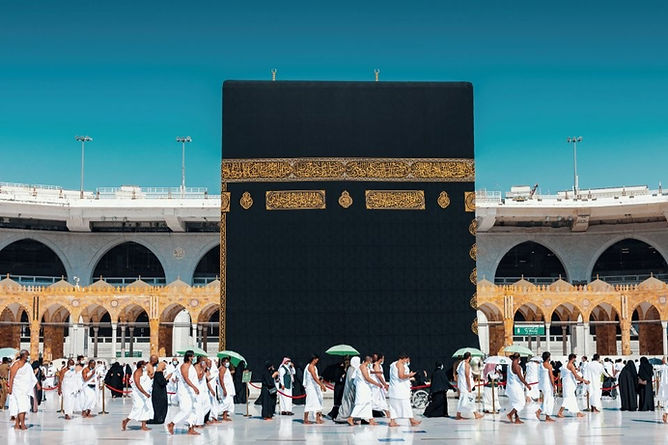
Zijarat - Mecca
Mecca, the birthplace of the beloved Prophet Muhammad and the place where the Holy Quran was first revealed, is Islam's holiest city. Nestled in the imposing mountains, Sirat Mecca is home to the Masjid Al Haram Grand Mosque, which houses the holy Kaaba – the holiest site on the entire earth. Being able to visit Mecca, Islam's holiest city, is the greatest blessing for Muslims around the world.
Every year, millions of devout Muslims from all over the world flock to the holy city of Mecca to celebrate Zijarat as part of the Hajj and Umrah pilgrimage. They visit several holy sites where the holy city is located, hoping to gain deeper insights into Islam and learn more about the beloved Prophet and the life he led here with his faithful companions. When you embark on the holy pilgrimage to Mecca, here are some of the top places to visit for Ziyarat during your trip.
Hira Cave
The Hira Cave is a highly revered site in Islamic history, standing on top of the Jebel al-Nour mountain. This is the place where the blessed Prophet Muhammad received the first revelation of the holy Quran. Measuring about 12 feet long and about 5.5 feet wide, the cave is about 3.2 kilometers from the holy city of Mecca.
The Blessed Prophet often meditated in solitude in the Cave of Hira, sometimes for several days together. At such times he would supply himself with provisions, so that there would be no disturbance in his thoughts. Seeing this key site as part of your Ziyarat will contribute to the blessings of your pilgrimage.
Jannat-ul-Mu'Alla
Maqbara Maula, or Ma'la Cemetery, is known by several names, including Jannat al-Mu'alla and Al-Ḥajūn. It is located 1 kilometer from Masjid Al Haram and is home to the tombs of several prominent personalities in Islamic history. It is the place where the first wife of the blessed Prophet Muhammad is buried, along with several other members of the Prophet's family and his faithful companions.
It is a very sacred place to perform Ziyarat, and dozens of people visit this historically important cemetery every year to pay their respects to the relatives of the blessed Prophet (pbuh) buried here.
Kwasna Cave
Also known as Ghar Thawr or the Cave of the Thaw, the Cave of Sour is of great importance in Islam. It was here that the Prophet Muhammad hid for three days with his faithful companion, Hazrat Abu Bakr, to escape the search parties of the Quraysh. The cave measures about 3.1 feet wide and has two entrances, one from the east and one from the west.
The history of Islam tells us that in order to protect the Prophet and his faithful companion, the Almighty had a spider weave an intricate web just above the entrance to the cave. The fully formed net prevented search parties from entering the cave because it meant that no one could enter without breaking it.
Jebel e rehmat
Jabal-e Rehmat is also referred to as Jabal-Ar Rahmah or the Mountain of Mercy and is located in Arafat. This is a very important place in the history of Islam, where "Syedna Aadam" and "Syeda Hawwa" descended from heaven. There is a white pillar that clearly shows the exact point where they landed.
Jabal-e Rehmat is also the place where the Blessed Prophet Muhammad (pbuh) preached his last sermon after the holy hajj ended. Getting to this point is crucial when performing the hajj, otherwise the pilgrimage will be considered invalid. It is a highly appreciated place to perform Ziyarat during the pilgrimage.
Masjid Nimra
Masjid Nimra is one of the most beautiful mosques you'll ever see, with two-thirds of it lying in the Arafat Valley and one-third being in the Uranus Valley and the Nimra Valley. According to Islamic history, the Prophet Muhammad (pbuh) camped in the Uranus valley and preached his famous last sermon after the hajj while sitting on his camel.
More than 100,000 Sahabah are believed to have accompanied him in his last hajj. The Nimra Masjid is of unparalleled importance even today, and it is the duty of the mosque imam to deliver the last sermon before the Dhuhr and Asr prayers are held together during the hajj.
Muzdalifah :
Muzdalifah is an important Ziyarat site in the holy city of Mecca. It is a mostly flat plain located between Mina and Arafat, where pilgrims spend the night outdoors after performing a series of prayers and rituals. Pilgrims perform Isha and Maghrib prayers in Muzdalifah. It is also the place where they collect pebbles, which they later use in Mina to symbolically stone the devil. They leave for Mina soon after the fajr prayer.
The Muzdalifah area has been marked to clearly mark the starting and ending points, and there are several mosques and rest areas for pilgrims. There is a built mosque on the hill of Mashur ul Haram in the region, which you can also visit during your Ziyarat.
Mine
Mina is a key site for Ziyarat and is also often referred to as the City of Tabernacles, as more than 100,000 air-conditioned tents are set up each year to offer temporary accommodation to Hajj pilgrims. This is where the pillars of the Jamarat are located, symbolizing the devil (shaitan), which pilgrims throw stones at on the last day of their pilgrimage.
Pilgrims stay two more days, during which they pray, read the Holy Quran, worship the Almighty, perform Zikr and listen to lectures on Islam. However, Muslims all over the world perform this ritual, and not only pilgrims for the hajj, during Eid-ul Adha. In the same place, animal sacrifices are also made at this time.
Masjid Jinn
The meaning of Masjid Jinn (or Masjid Haras) is paramount in Islam. The mosque was built on the exact spot where the blessed Prophet Muhammad (pbuh) drew a line for this faithful companion, Abdulla bun Mas'ood, after the Prophet (pbuh) was instructed to recite the holy Qur'an to the genie. According to Islamic history, the jinn came in many branches to hear the holy Quran, after which they swore allegiance to the Prophet and embraced Islam.
The holy mosque is one of the oldest and most important mosques in the region, it is also called the Mosque of Fidelity and the Mosque of the Guard, because it is patrolled by city guards.
Sacrificial Place
Jamarat and Mina Jamarat is located about 6.9 km from Masjid Al Haram in the east direction. It is here that the three pillars denoting the devil (shaitan) are located, which pilgrims must throw at them on the last day of the hajj. It is also a place where animal sacrifices are made during Eid ul-Adha.
According to Islamic history, this is the place where the Prophet Ibrahim was said to have sacrificed his son and where the devil approached him and tried to dissuade him. The throwing of stones at the 3 pillars and the offering of sacrifices is done in remembrance of these events and the Prophet's unwavering faith in the Almighty.